

Products for children's eating
Security with every bite
On
supplier program where we have procedures and approaches for how we manage our suppliers. Read more about our purchasing policy here.
OUR PRODUCTS
Highest possible security
Highest possible security
Our products are developed with a focus on safety, quality and function – in accordance with current European legislation. When it comes to products that come into contact with food, safety is about both materials and construction – that the products are non-toxic and safe to use in everyday life.
Non-toxic products
Our products meet the EU's strict requirements for chemical emissions under the REACH Regulation and Regulation (EC) No 1935/2004 on materials intended to come into contact with food. This means that the products are safe and do not release any toxic chemicals when used.
Child-safe design and testing
For products where relevant, we work based on established European standards for children's items, such as:
· SS-EN 14350 (beverage products such as cups and bottles)
· SS-EN 14372 (children's tableware, cutlery and feeding utensils)
These standards include requirements for materials, construction and safe use. For products where these standards apply, tests are carried out that may include, for example:
· that the product can withstand normal use and load
· that the design is adapted for use by small children
· that the product does not contain harmful substances
This means that our products have a design that is adapted to the needs and development of young children.
Certifications
LFGB certified material
We only purchase materials that meet the German LFGB quality standard, which is the strictest standard for materials in contact with food. This certification guarantees that our materials are safe in contact with food and do not emit any harmful substances regardless of heating.
To maintain the high standard, we also work continuously with Eurofins in Denmark, which conducts quality tests of our products (in the form of random samples).
We test, among other things:
- If the product releases any substance when in contact with food (for example, in contact with vinegar, fat and water).
- If the products contain volatile organic compounds (VOCs) that can be harmful to humans.
- If there are any heavy metals in the products.
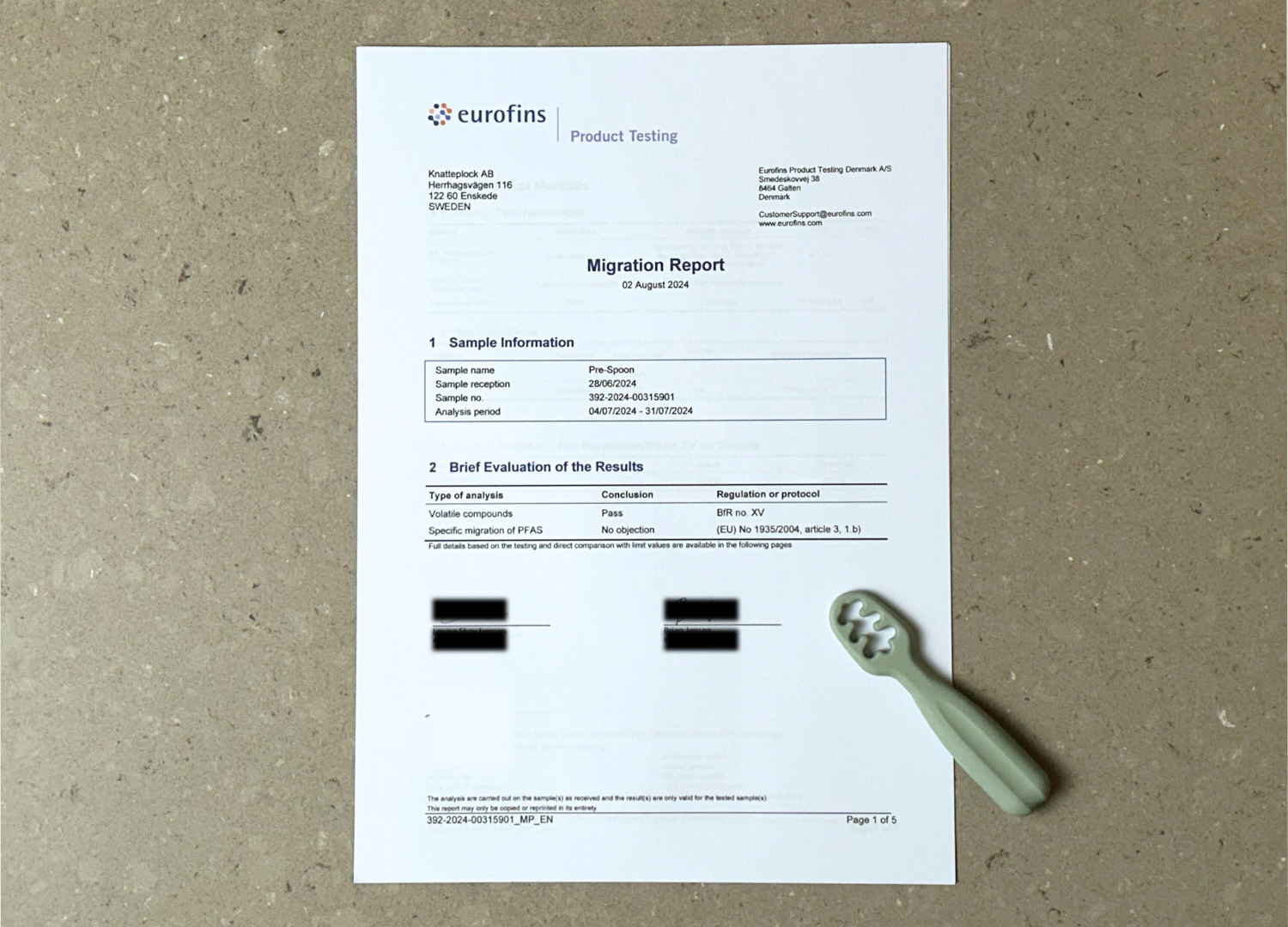
In collaboration with Eurofins, we test our products according to the Swedish child safety standard SS-EN 14372 (something that is not otherwise included in the LFGB certification). This includes additional substance testing (to ensure that our products are safe for children to use):
- Volatile organic compounds (VOCs)
- Release of the following substances and their sum:
- Antimony (Sb)
- Arsenic (As)
- Barium (Ba)
- Cadmium (Cd)
- Phthalates
- BPA
Our different materials
Products in safe materials
The majority of our products are made of silicone. Silicone does not yet have material-specific legislation in the EU, as many other materials do. Therefore, it is extra important to choose high-quality silicone. You can feel safe when buying our products, as we only use LFGB-certified silicone and carry out extensive testing to ensure they are safe for your child.
Our plastic products are also made from LFGB certified materials. For plastic, testing primarily focuses on identifying substances such as microplastics, phthalates, chlorinated paraffins, PFAS and other highly fluorinated or endocrine disrupting substances that can be released during use.
Thanks to the fact that all our products are made from LFGB-certified materials and continuously tested via random samples, you can be confident that they are completely non-toxic and safe to use in everyday life for your child.
Why do we use silicone?
Silicone is a safe and durable material, and because we only use high-quality silicone, you can be sure that our products can withstand both everyday wear and tear and high temperatures.
Advantages of silicone

Silicone can withstand both high and low temperatures without melting, breaking down or losing its properties. This means our products can be used in the microwave, dishwasher, freezer and oven.

Silicone is flexible and retains its elasticity even under tough conditions. Even if your child drops or throws the bowl on the floor, the silicone will hold its shape without cracking or getting damaged.

Silicone is one of the most chemically stable materials and does not react with other substances, making it perfect for contact with food. It is also long-lasting and can withstand intensive use.

Silicone is hydrophobic (water-repellent), which means that liquids do not stick to the surface. This makes our bowls and plates
easy to clean and remain hygienic after each use.

Unlike plastic, silicone does not break down into microplastics and it also has a long lifespan. Silicone can be reused and recycled, making it a more sustainable material in the long run.
Frequently asked questions (FAQ)
Yes, silicone is a safe material for contact with food, provided it is of high quality and certified. Our products are made from food-grade silicone that has
undergone strict testing to meet international safety standards.
No, silicone cannot contain microplastics. Silicone is a synthetic material that differs from plastic in terms of its structure and degradation process. Unlike plastic, silicone does not break down into microscopic particles called microplastics. Overall, silicone has a longer lifespan without releasing harmful microplastics over time.
Only buy high-quality silicone (preferably LFGB) from trusted manufacturers/brands and that are intended for the right purpose. If the product is to be used with food or exposed to high temperatures, it is important that it is made of food-safe silicone.
Some products are marked with a symbol consisting of a fork and glass. However, the absolute best thing to do is contact the company and ask what standard they use for their silicone products.
LFGB is a German quality and safety standard for products that come into contact with food. Our product materials are tested and approved according to this standard, which means that they do not release harmful substances, and that they are safe to use according to European legislation.
FDA, like LFGB, is a certification for food-approved materials and products. It is discontinued
from an American standard that is less strict than LFGB (which is a German standard). We have chosen to adhere to the more strict certification (LFGB) as we have a sensitive target group that we are concerned about, namely children.
We chose silicone for its superior properties – it’s flexible, durable (we know how many plates get dropped on the floor every day), chemically stable, and safe for use with food. Plus, silicone is a reusable material with a long lifespan.
The glass and fork symbol, which indicates that a product is safe for food contact, is not mandatory on all products. The exception is products that are clearly intended for food contact, such as our cutlery. In this case,
The consumer has no doubt about what the product is to be used for.
The glass and fork symbol is most often used on products whose purpose is not obvious, such as our snack button, which we have marked with this symbol on the packaging.
Silicone products may smell when first used and especially before they have been washed. However, they should not continue to smell after several uses, if the product continues to smell, please contact us.
However, silicone can absorb the taste and smell of dishwashing detergent, but there are ways to take care of it. Read more about it here.
Only toys and electronic products must be CE marked. Children's items, which we sell, are not toys and therefore do not have to be CE marked. Children's items are subject to completely different regulations and belong to a completely different product category than toys.
No. We do not allow these in our products, as we do not consider them safe enough.
Summary
By